|
One
Back to Our Battlefields
For us it was an irresistible urge that gnawed at us for
nearly three decades—a need to return and walk the
blood-drenched soil of the Ia Drang Valley of Vietnam,
where two great armies clashed head-on in the first
major battle of a war that lasted ten years and consumed
the lives of 58,256 Americans and perhaps as many as 2
million Vietnamese.
Joe and I had tried twice before, in 1991 and again in
1992, to reach the Ia Drang during our research trips to
Vietnam. The Vietnamese government officials in Hanoi
had flatly refused permission for such a journey,
uncertain whether we had some hidden agenda among the
restive Montagnard tribal people in the Central
Highlands where our battlefields were located. Or
perhaps because our battlefields were located just five
miles from the Cambodian border and Khmer Rouge
guerrillas had been raiding across the border in that
area, creating havoc in the thinly scattered villages
near that border.
When we suggested on our 1992 visit that we might simply
hire a car and set off south to visit the Ia Drang, our
Foreign Ministry minder pointedly said if we left Hanoi
on such a mission we would be "followed by a car full of
people; not very nice people; and we won't be able to
help you then." Only with the publication of Joe's cover
article on the Ia Drang in U.S. News & World Report and
the release of our book—both translated into Vietnamese
and very carefully read in Hanoi—did the roadblocks fall
in the fall of 1993.
We had proved by our writings that our only desire was
to accurately report what had happened in the Ia Drang
Valley, and we were just as interested in their version
of this slice of history as we were in our own. Visit by
visit, article by article, our hosts warmed to us
personally and to our quest for the ground truth about
battles that had deeply affected our lives and theirs.
There was another important factor: The world had
changed. Communism had died in the Soviet Union and was
being transformed in neighboring China. The rise of the
Asian tigers—capitalist neighbors like Thailand,
Malaysia, Singapore, and Indonesia, whose economies were
booming—had not gone unnoticed by Hanoi. They were
maneuvering to gain initial diplomatic recognition by
Washington and were seeking foreign investment and
most-favored-nation trade terms. This would not come for
another year. Communism was alive in Vietnam but it was
busy putting on a new face.
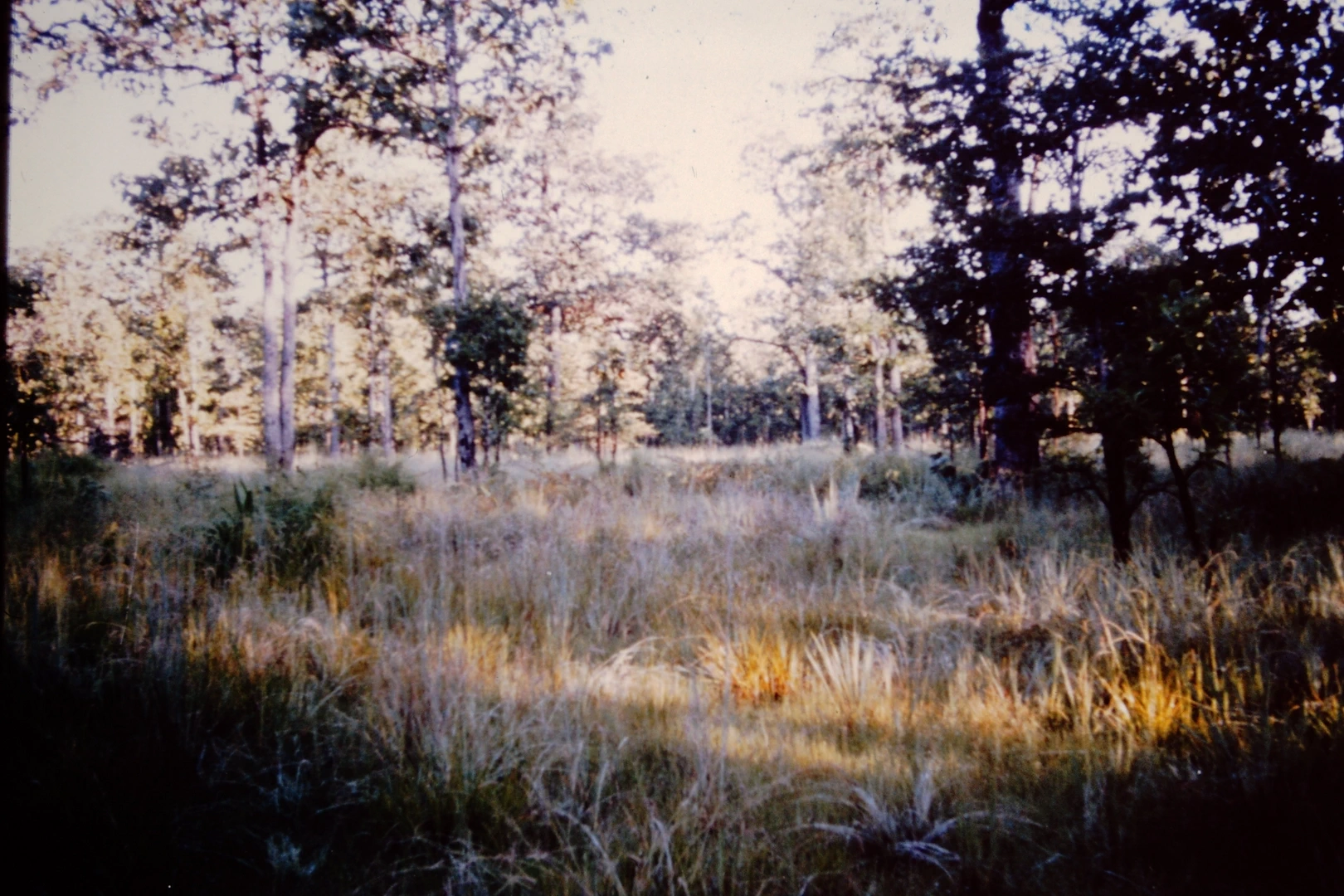
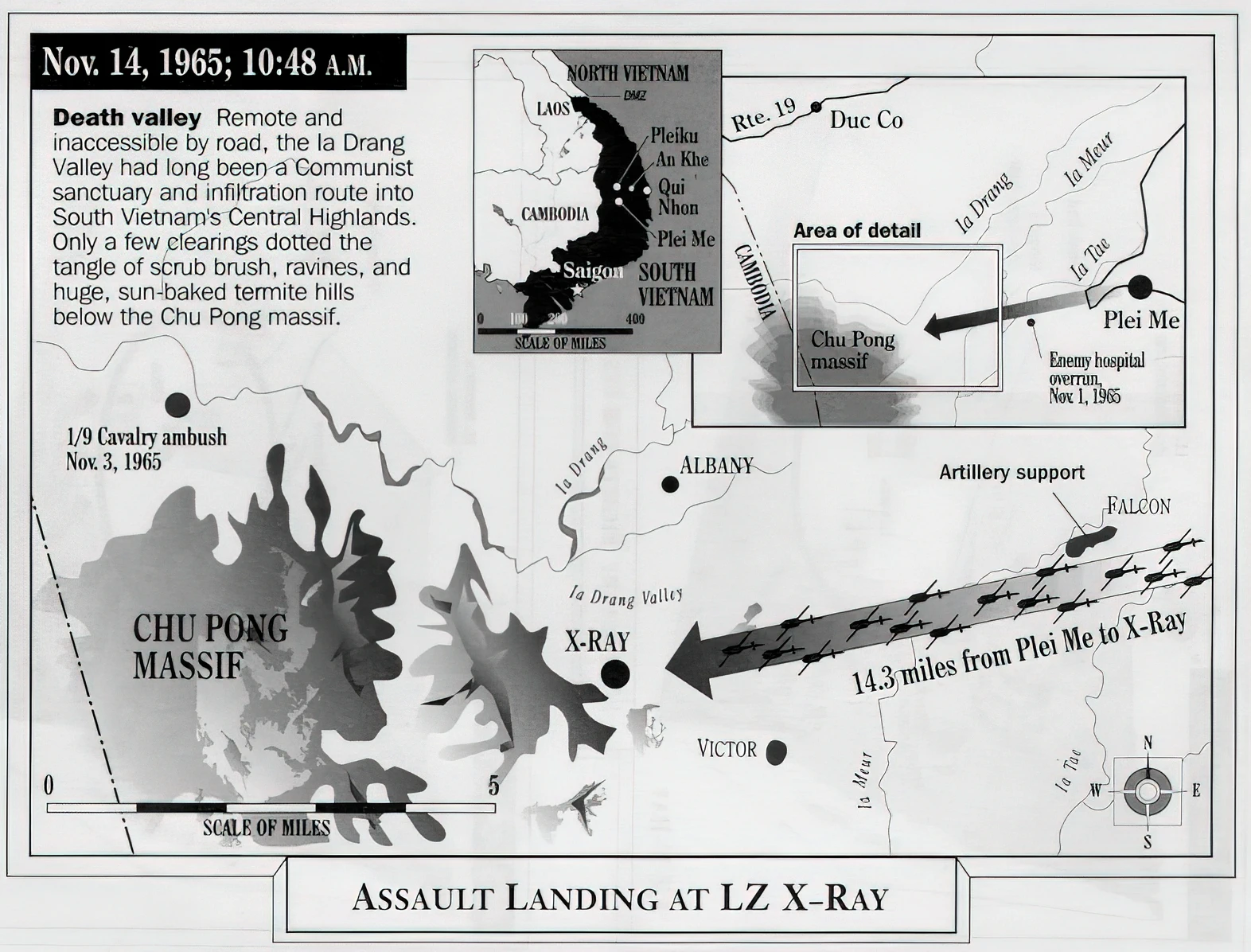
Now, in October 1993, a chartered Soviet-made Hind
helicopter was lifting off the runway at the old Camp
Holloway airfield at Pleiku in the Central Highlands of
Vietnam. The two Vietnamese civilian pilots confessed up
front that they had no idea where, in that rugged
plateau that butted up against the Cambodian border, the
football-field-sized clearing code-named Landing Zone
X-Ray was located. So Bruce Crandall, one of the most
experienced pilots in Army Aviation, and I knelt in the
narrow space between them in the cockpit, unfolded my
old and detailed Army battle map, and, using Joe
Galloway's even more ancient Boy Scout compass, pointed
the way to the place where our nightmares were born.
In the back of the rattling old helicopter was an
assemblage of American and North Vietnamese military
men, old soldiers all, who were journeying together to a
place where we had all done our very best to kill each
other in one month of ambush and assault and set-piece
battles in November 1965. It was here that the men of
America's 1st Cavalry Division (Airmobile) and those of
the 66th, 32nd, and 33rd regiments of the People's Army
of Vietnam (PAVN) had tested each other in the crucible
of combat. An estimated 3,000 to 5,000 North Vietnamese
regulars had been killed or wounded. A total of 305
Americans had died and another 400-plus had been wounded
in that time of testing. No one who fought there, on
either side, talked seriously about who won and who
lost. In such a slaughterhouse there are no winners,
only survivors.
What had now brought this little group of survivors
together to travel back to a painful shared history? It
was, of all things, a book published a year earlier that
opened long-closed doors and allowed us to make this
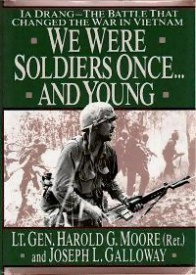
needed journey. The book was We Were Soldiers Once . . .
and Young, written by Joe and myself.
We were bound, in this thirty-five-mile flight, for the
jungled mountain plateau near the Cambodian border where
I had led my beloved troopers of the 1st Battalion 7th
U.S. Cavalry in a helicopter air assault into a battle
where we would be vastly outnumbered at times. That any
of us survived is testimony to the fighting spirit of
the great young Americans—the majority of them
draftees—who, when their backs were to the wall, fought
like lions and died bravely.
Had I commanded the men on the other side I would have
said much the same thing of the North Vietnamese peasant
boys drafted into their own army and sent south down the
Ho Chi Minh Trail to intervene in the war raging in the
southern half of the country. They, too, fought bravely
and were not afraid to die in the storm of napalm,
bombs, artillery shells, and machine-gun and rifle fire
we brought down on them. Now their commander, Lt. Gen.
Nguyen Huu An, and I were in the air, returning together
to that ground hallowed by the sacrifices of our men.
This time we came in peace, old enemies in the process
of becoming new friends—something that would have been
inconceivable just two years before.
These seminal battles that opened the waltz in
Vietnam—which would stand as the bloodiest of the entire
Vietnam War—had been largely forgotten in the long years
of combat that followed before helicopters lifted the
last Americans off the roofs in downtown Saigon in April
1975.
Joe, a war correspondent who had stood and fought beside
us in Landing Zone X-Ray, and I had made two trips to
Vietnam in search of the story of those who fought
against us. These trips resulted first in a cover
article Joe wrote in U.S. News & World Report on October
29, 1990, on the twenty-fifth anniversary of our
battles, and then in a contract to write our history of
the battles. It was not lost on our former enemy
commanders that we had dealt honestly with them and
quoted them accurately in both the article and the book.
When ABC television and the Day One program offered to
take us back to Vietnam to make a documentary film, the
Vietnamese authorities in Hanoi agreed to all that we
proposed, including the long-denied trip back to the
battlefields in the Central Highlands.
Why this obsession with a remote clearing so far from
anywhere? What had happened here years before that
indelibly seared the experience into the minds and
hearts of men who had fought in other battles and other
wars? Those dark November days of 1965 still powerfully
grip the imagination of those of us who survived the
battles of the Ia Drang on both sides.
Late on Saturday, November 13 of that year, my
undersized battalion of only 450 men—most of them
draftees led by a hard corps of career Army sergeants
who had fought as Infantrymen in Korea and World War
II—was ordered to make an air assault by Huey
helicopters deep into enemy-controlled territory just
five miles from the Cambodian border.
The orders to me were simple: We believe there is a
regiment (about 1,500 troops) of North Vietnamese Army (NVA)
soldiers in the area of the Chu Pong Massif, a craggy
spine of tumbled peaks over 2,300 feet high that ended
at a clearing not far from the Drang River but reached
back over ten miles into Cambodia. Take your battalion
in there and find and kill them.
|